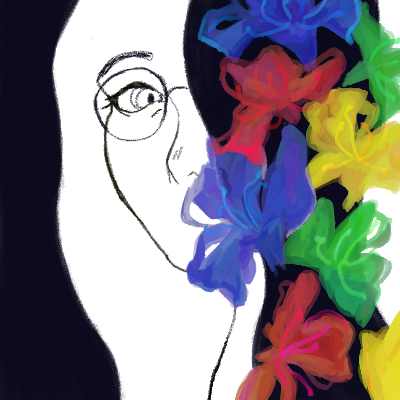
by Isa Mari De Leon
Medium: Poem
Year: 2024
Publication: Unpublished
Genres: Sci-fi, magical realism
Dazzlin’ Dina spent her Sunday dawn—her final Sunday and her final dawn—rehearsing.
The phonograph record spun a ditty from the decade previous—from out of that decadent roar came this lullaby for a babe, tempoed up into swing music for dogs and cats and brass to dance to. It was corded in Dina’s memory bank as one of her favorites. A bit nostalgic, it was, though her wires and filament knew nothing about that. Her voicebox crooned, the makings of a singalong bubbling out of her metal mouth. Bubbled, bubbled, then—popped. She took a tinny breath in, held, blew out, though there was no need for it. She started again. Bubble, pop. The sounds flowed out of her, then flung abruptly, hitting the walls of the empty dance hall. Croon, croon, croo—oo—oo—
Her voicebox quavered.
Dina stopped. With brass hands, she smoothed down the copper of her forever-flapper dress. She blew a puff of air out of her mouth—a pattern she had picked up from observing her maker, who did it to get her chin-length hair out of her face.
Footsteps sounded from the attic, soft plods down the stairs. A wooden door marked “EMPLOYEES ONLY” opened, and in stepped Dina’s maker, Joan.
“You’re all powered up,” Joan said above the swing lullaby. She still wore her sleepwear and rubbed the tired from her eyes. “In the dark. Can you see what you’re doing?”
“I am singing, I do not need to see.” Besides, her ocular lenses were too simple to process light and color in too great detail. Black and white was her world.
“Singing, at this hour, you’re…” Joan looked at the phonograph and back at Dina. “Practicing?”
“Yes.” Dina had not practiced since her first year as a croonerbot, and that was less practice and more testing. Practice went against her wiring; it was illogical. She was already corded to memorize songs, keep rhythm, belt notes. Practice was paradoxical. It wore out her voicebox when it would be wiser to conserve its quality.
Joan walked up to the elevated platform where Dina stood. “Oh, my girl. You nervous?”
Dina’s memory bank could not process some knowing to that question. During her powered-down time the eve before, her coalite core had fluttered with—something. Flashes of light had fired behind her ocular lenses throughout the night, blinks of faces and memories she could not place, and she woke shuddering, shaking away the vestiges of a strangely full sleep. Her limbs powered up with her. She could only identify and advance the inclination to rehearse, and so she came down here and tried it.
After some moments without Dina answering, Joan clucked her tongue and stopped the phonograph. The music fizzled away.
“S’alright. It’s natural. Well, maybe not natural, I didn’t cord you with nerves, but it’s a known… Hm…” Joan pressed two fingers to the underside of Dina’s chin, tilting it gently side to side, this way and that. “A known phenomenon. Dinas before had the same itch, up to their last performances.”
“Really?” She didn’t know how to feel about the mention of other, previous Dinas. Previous selves.
“Yes. Usually’d show it a few days before showtime, I think a week before, for the first. That you’ve got some hankering the day of is probably an improvement.”
Her coalite core flittered.
“Come on now. Let’s get you some fuel. You didn’t burn this morning, did you?”
Dina shook her head. Joan led Dina back up to the attic.
Unlike the dance hall, which was all walls and strung-up lamps, the attic let in a little of the burgeoning natural light through small, high-up windows. The attic was a cramped space, just one rectangular room, with motley and messy divisions between the living functions: A kitchenette with a three-person table, a smattering of non-perishables in the pantries, and Dina’s sack of coalite. A family corner with scattered artificery tools, a sewing station, board games. A sleeping area with wool blankets and a mattress on the floor, where Marvey still slept.
“Can you sit by him after you’ve eaten? He might be cold still,” Joan said.
Dina flicked on a light switch. It took some waiting and flipping off and on for it to be steady, or steady enough. They walked to the dining table—though it was more of a desk, with a circular wooden top and legs holding on, two fine and one bad. Joan lifted the bag of coalite and set it atop the table. Dina stood. Joan took a seat in front of her. She opened Dina’s combustion chamber, a door on her torso. Then she opened the coalite bag and had to scrape the bottom to get half a shovelful of substance.
Meanwhile, Dina’s lenses glazed over the newspaper clippings and photographs hung up on the wall beside them. On all of them: Dina, Dina, Dina. The first one at her first show, dated the start of 1919. Her metal was styled as a day dress, long-sleeved and carved with a necklace. She debuted in a theatre, to a booming crowd. The war to end war had just ended; she sang in celebration for five years before she had to be wiped and given a new form. Then: the second Dina. The New, New Woman—arms bare, knee-length dress, free to move and croon to a cabaret crush. Six years strong. Then the turn of a decade, the turn to this third Dina. She opened to hard, hard times and thin, thinner crowds. Up for seven years, now.
Better, wasn’t she? What did she sing for? Her exposed workings, the open door—ached.
Amid all these mentions of Dina, there was nary a footnote for Joan. She placed the coalite carefully within Dina, setting bits at even spaces for even burning. Nodding, she closed the door and wrapped up the sack.
“Thank you,” said Dina.
“Of course.” Joan stood. “I’m sorry we don’t have more.”
Dina nodded. She went to sit by Marvey. The coalite simmered within her, releasing smokeless warmth.
Marvey, Joan’s husband, slept unsteady most of the time. Or did not rest at all. Night terrors, he had, on account of the shell shock. Those nights, when Joan or Marvey had the mind for it, powered up Dina and set her to sing his favorite songs: ballads, slow in pace and true of heart—though Dina knew nothing about that. Right now, however, he did not look in need of music. His eyelids were gently closed, his lanky limbs relaxed. Maybe it was the new coalite traveling up the wires in her mind, but she wondered what he dreamed of, if this morning he dreamed.
Dina hummed, anyway. Marvey awoke slowly, then all at once.
“Dina,” he yawned. “Dina, Sunday…”
“Good morning, Marvey.” She kept humming as Marvey got closer to waking, yawing and stretching. “I would like you to walk with me.”
He nodded.
“To Beryl’s.”
Joan overheard and chimed in. “She’ll be here tonight.”
“I know. I would like”—I want, Dina thought—“to see her before that.”
Marvey went to Joan, who was now fixing up some food for two. A whispered conversation took place. Marvey gave her a somber look. Joan called him “Marvin.” Dina continued to hum. Marvey came back to Dina and Joan returned to cooking, lowering the portions for just one.
He nodded his chin toward the door.
“Now? I can wait until you’ve had breakfast.”
He shook his head and shrugged.
Morning turned into noontime during the walk to Beryl’s. Today was a dreary, common day in San Francisco. Cable cars went by, as did automobiles. An outdoor bread line was formed on a street corner. They passed a toy store that previously sold dolls of Dazzlin’ Dina, but it had been closed. A couple of government workers manned an automaton buyback line.
“You will be compensated generously,” announced one of them, a showman in a suit and tie. “The last decade was the Age of Prosperity, the Age of the Automaton. Now staunchly in the Age of Scarcity, we must recollect ourselves. Be rewarded now and be rewarded later—when Uncle Sam has the research and materials to fuel a great resurgence of the Machine. Imagine if every household had its own mechanical caretaker. Or if the European war had been fought with bots instead of men. To sell is your duty as an American; to buy is our right as the government of America. Let us prepare ourselves and our country for the future!”
Marvey led Dina across the street to keep to themselves. Along the way, Dina saw the signage advertising her final show.
Beryl lived not too far, in a neighborhood vibrant with art, performance, and poverty. Her residence was less a house and more a hovel. But the humble appearance belied the nature of the person who answered the door.
“Dina, Marvey! Wasn’t expecting you,” Beryl said.
“Yes. We did not call beforehand.” Dina tried to make her voicebox sound apologetic.
“More than dandy. It’s Sunday, I can spare you some time on the dime. C’mon in,” she stepped to the side. Dina entered, but Marvey stayed back.
”Marvey?”
He held a hand in front of himself, declining. “Bring, bring her back later.”
“You got it.”
Marvey and Beryl gave gentle smiles to each other. Dina’s mouth twitched at its dimple-like rivets. Beryl closed the door, and they were alone.
“What can I do you for, Darling Dina?”
“I—wanted—to see you.”
“Well, consider me seen.”
“No, Beryl. I wanted. Isn’t that… just something?”
Beryl considered. “You’ve wanted things before, haven’t you? Wanted to sing, entertain, do a good job?”
“Those, I was corded to achieve. Only today I find I’m wanting other things.”
“Like what?” Beryl spoke with an openness to her face that Dina, if she were able to evaluate such things, would call handsome.
Dina selected her words, siphoning them through her coalite-warm mind. “Would you play? For the sake of playing?”
Beryl watched her for a moment with that stricken honesty, before she blinked and chuckled. “‘Course. You got it.”
She retrieved her saxophone. It shined within Dina’s monochrome world. She slung it round her neck; warmed it up and let it breathe. Coaxed it toward some simple notes, first, just to get a feel for it. Then she played something friendly and good-natured—she and this instrument which had been at Dina’s side starting midway through the crooning career of the second gal, the bold and gold gal—nine years all told with Dina, just about. She was sixteen then, when she started saxophoning, really saxophoning. She was twenty-and-five now, and looking back let her put that amateurishness in there, stumbling through the notes as that teenage mess. Then she let the song mature. She developed its sense, its mind, its wings. It got purpose. Melody and meaning: some girls building a job, a name. The notes drew on; they had something to say. Here it turned—not dark nor jaded, but deliberate, and a little bit hungry. Then finally, she guided the song to speculate on itself, to age. There was an air of sadness about it—the blues, and a soul as bright as Beryl could revel in and rebel against that sadness, those depths.
Dina watched and listened. It was as if she could see the blue of the jazz, laid over her reality like a blanket. As Beryl’s playing drew to a close, Dina took on some of that openness from Beryl’s face.
“Beryl,” Dina said. “That was lovely. Very lovely.”
“Thank you, darling. Just some improv, you know,” Beryl said, breathless from playing. She put the saxophone away.
Some improv, some impulse. Dina followed the pushes of coalite core, thrumming in the chambers of her engine.
“Would you dance with me?”
“Right now? Sure, but, what’s gotten into you?”
Dina did have an exact answer, but found she could ignore that imperfection. She wanted to dance for the sake of dancing. She clasped Beryl’s hand within her rusted own and put the other on Beryl’s shoulder. They had no music, just the memory of it, of what Beryl just played and the near decade of what she played before.
“I think I had a—dream, about you, in the night,” Dina said, swaying. Beryl’s eyes widened. Dina continued, “I remember your face. But you appeared younger. It wasn’t from one of our shows. Or,” a twinge of blue showed through her voicebox, “I suppose it was.”
“Oh, Darling Dina. Dreaming Dina.”
A clarity overtook Dina, then: a smokeless fire behind her lenses. “You—loved—me?”
Beryl nodded and gave a small, sad smile. “And I’ll love the next you, too.”
Afternoon filtered in through curtained windows. They danced like this for a while, until Dina faltered in the rhythm:
“Are you worried about tonight?”
“Worried? No, not at all. You’ll sound stellar and I’ll be playing right by your side.”
Stellar enough to stay? Dina thought. Stellar enough to be this Dina for a little while longer?
“And after?”
“Joan’ll do what’s gotta be done.”
“But why?” Dina said, a harsh whisper through her speakers. “Why must it be done?”
Beryl took charge of their movements. “I asked about this, with the past you. She herself said it’d be a pain to go on as she was. I saw it, too. Her body just… wasn’t keeping up.”
Dina’s grip tightened. “But that was her. I am me.”
“I know. I know you are.”
“And what’s a bit of pain?” Dina bristling, now, with a crackling—angry—hiss. Pain: she had no conceptualization of how vast that four-letter word truly was. But at this moment, she felt it—and wanted to feel it.
“I don’t think any of us wanna see you hurting, if we can help it.”
Dina stopped them in the center of the room. “I—I already am. Let it happen. Let me try.”
Beryl looked into Dina’s eyes. Heard the tremble in her voice. She found something unrobotic—something, someone, alive. “Who’d I be to stop you? Talk to Joan, tonight.”
Dina reeled back, nodding and nodding more.
“We still have some hours before showtime,” Beryl said. “What do you wanna do?”
She considered. The hunger to practice from this morning still had not been entirely sated, amplified by the shortage in coalite. But beyond the hunger to perfect what she was made for, there was also a restlessness to defy it.
“I would like… to rest.”
“Rest?”
“Yes. Power me down and wake me up when we need to leave.”
Beryl again granted that frank, unvarnished smile. “Sure thing. Sleep and dream.”
Dina’s sleep was indeed full of dreams, the fires inside turning to brilliant rays of light behind the eyes. She awoke with that shine, blinking beneath her rust. Under a violet and orange sunset that Dina saw in rich black and white, they went to the dance hall. Batches of partygoers had gathered at the front. Joan was outside, smoking a cigarette, and she ushered Dina and Beryl inside upon seeing them approach.
“There you are. Are you both ready?” Joan stamped out her cigarette. “Dina, do you need anything—oil? Tune-ups?”
“I would like to speak with you.”
“Of course, of course, Beryl, would you help Marvey set up?”
Dina and Joan went to the attic.
Under the blinking attic light, Dina said, “I’m scared.”
“Pardon?”
“I’m afraid,” her voicebox filled the empty air. “I don’t want to be shifted into a new Dina. Why do you do it?”
“My girl.” Joan’s voice was tender with old smoke. “For new starts, new selves. No getting bogged down by the past. More chances to get things right.”
“Are they new chances for me, or you?”
“For us both.”
Dina evaluated. She could hear Beryl begin warming up, notes drifting from below. Joan was right, and she was wrong. She was selfish while trying to be selfless. And Dina could not begrudge her for these contradictions—because she wanted such contradictions for herself.
“I want to be burdened by the past, yet excited for the future. I want to get things wrong. I want to hurt.” I want to be human, she thought.
Joan took one of Dina’s hands in both of hers. “I don’t know all that would happen to you. All I know is—there is pain. Parts and wires deteriorate, but the core stays, and is wiped clean to remove those memories of the hurt. If we let the body slip, what if the heart goes with it?”
“Then it goes,” said Dina.
Joan looked now at the flickering lamplight. At her wall of photographs, at the mattress by the wall. Within the attic’s small windows were a smattering of stars. “Let me—let me think about it. In the meantime, enjoy tonight. It’s your celebration.”
Dina looked at her with lenses alight—lenses alive. She nodded and descended to the dance hall.
The hall was bathed in a hazy, colorless light. Though Dina did not have nerves as a human did, she could feel that there was warmth. People had entered and mingled. Marvey had set up a bar as a silent, steady watcher. He smiled at her. She tried to smile back, even though it pulled at the rivets of her mouth. Beryl welcomed her and pulled her up to the stage. Together, they made harmonies for the night.
Dina sang. She sang for her maker’s hurting. For Marvey’s. For Beryl’s. For her own. For the aches in her voicebox and coalite core. For the fleeting feelings, those that awoke in her today. For the music itself, which would only be played this way, at this moment, and never this way again. For the sadness of a Sunday turning into a Monday that she may not live to see. For the hope of seeing it, anyway.
She sang, for it was human. It was painful, and it was beautiful.
I first drafted The Gone-Song under some pressure, as a final assignment for a spec-fic creative writing class. I wasn’t going through anything crazy—I was on vacation at Disney World, writing on my phone while waiting in line for rides or taking a sec to sit my tired limbs down. I was inspired by the image of an automaton breaking down (not at Disney World, they wouldn’t allow something so vulnerable), feeling a similar pain humans feel as they age. Bones weather, a voicebox breaks down.
But more overarchingly, The Gone-Song was written during the explosion of generative AI technologies. As an artist, I’m quite staunchly anti-AI, for a number of reasons—most pressingly, for how I believe it bypasses what makes art, art. Art is messiness, fallibility, imperfection, intention: humanity, on display.
 ISA MARI DE LEON